|
For comparison of Stand Alone Mechanical Demining by KMMCS with work of manual deminers in terms of time and cost and reliability can be provided several calculations and one proove of severe methodically clearance falt serie of manual deminers.
|
|
|
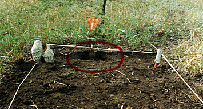
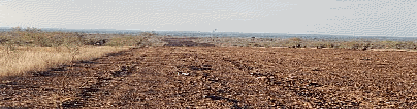
| Manual demining result | Stand alone mechanical mine clearance result |
1. Comparison of costs and speed in Mozambique
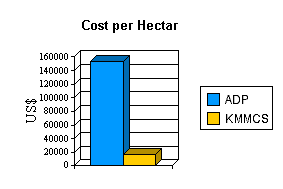
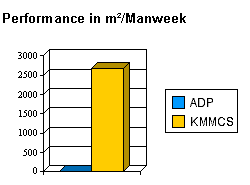
In Mosambique the demining operation of KMMCS with comparable mine clearance operation of almost the same size (details see below) done by manual deminers of UNDP-Accelerated Demining Programme (ADP) caused a the costs per mine of only 8.46%. In terms of cost per hectar the KMMCS caused only 10.5 %. The performance of the Stand Alone Mechanical Mine Clearance expressed in terms of cleared area per working time of a manpower is 197.5 times as of a manual deminer.
|
|
|
||||||||||||||||||||||||||||||||||||||||||
Basis of figures
| ADP had cleared 56 hectar in 20 months from June 1994 until March 1996 with 10 Platoons (500 manpower). | KMMCS had cleared 56 hectar in 6 weeks of working time (250 h) with 35 manpower, destroying by it 6435 mines. | ||||||
ADP costs
|
|||||||
| The price per ha was 16 200 US$ (incl. all extra charges) | |||||||
| The price per mine was 148 US$. | |||||||
| The area is ready to be planted. |
Sources: beside others: Parlament questionaire http://dip.bundestag.de/btd/13/045/1304537.asc (opens separate Browserwindow) of Member of Parlament Bundestag) Angelika Beer and fraction BÜNDNIS 90/DIE GRÜNEN. BT Drucksache Nr.13/4537: Expenses for humanitarian demining in budget 1996.
Answer of Federal Government as Bundestags print 13/5187: http://dip.bundestag.de/btd/13/051/1305187.asc Searchable at http://dip.bundestag.de/parfors/parfors.htm or at http://www.parlamentsspiegel.de(
Drucksachen, Plenarperiode 1996 Anzeigen http://www.parlamentsspiegel.de/Webmaster/Dokumente/bund_parlamentspapiere.htm http://www.parlamentsspiegel.de/WWW/Webmaster/GB_I/I.4/Dokumentenarchiv/dokument.php?pl=BA&part=D&pnr=13/5187&quelle=parla)
2. Comparison of speed in Moamba
While celebration at 05. April 1996 for return of the areas, which had been
clearead by KMMCS in District of Moamba it had
been made public  :
:
Approx. 70% of the area cleared by KMMCS already is agricultural use again by planting of corn,, beans, peanuts and onions.
In 22 months approx. 44 ha
had been cleared by more than 400 manual deminers.
In 5 months 16 men and the 3 machines of the Krohn
Systems had cleared 56 ha and prepared to be planted. Thereby 6400
mines had been destroyed. These were 50% of the mines that were destroyed in
more than 2 years in all of Mozambique.
3. Comparison of speed in Report of german Bundesregierung
In a report of german Bundesregierung from 20. Sept 1995 at Subcomittee for dissarmament and Arm Controls, -712- UA1 -2401- at Page 6/10 is stated:
|
VLR Wokalek explained: ...(about international funding and documentation effort of Bundeswehr for the mostly used 600 mine types and bad experience of demining activity in Cambodia and remining shortly after demining)
|
| direct from report | Manual deminers | KMMCS |
|---|---|---|
| Number of persons | 2 manual deminers | 2 drivers |
| Time | one day | 45 min |
| cleared area | 2 m length × 1 m (regularily, therefor assumed) width | 500 m length × 4 m width |
| normalized | Manual deminers | KMMCS | ||
| Number of persons | 2 manual deminers | /2 | 2 drivers (in shift) | /2 |
| Time | one day (max 5 h permitted / person each day) (assumed total 10 h = 600 min) |
600 min | 45 min | × 13,33 |
| cleared area | 2 m length × 1 m (assumed) width | 2 m² | 500 m length × 4 m width | 2000 m² |
| 1 m²/day/person | 13333,3 m²/day/person |
4. Comparison of Speed and Cost saving at Combat Training Center, Hohenfels, Germany
The report about the clearance at Combat Training Center, Hohenfels, Germany contains some paragraphs about reduction of cost and speed by KMMCS in comparison with the manual deminers.
|
Field Test of a Mechanical Demining System on an Impact Area From 26. June to 29. July 2000, the U.S. Army Corps of Engineers (USACE) tested the effectiveness of the Krohn Mechanical Mine Clearance System (KMMCS) at an ordnance project at Combat Training Center, Hohenfels, Germany. The KMMCS was used to assist in the subsurface clearance of an impact area for antitank ordnance. The site had also been used as a demolition area for many other kinds of ordnance. Several factors led to the decision to test KMMCS.
Concentrations of unexploded ordnance (UXO), ordnance scrap and
target scrap were much heavier in the target area than had been
expected. The clearance team had spent 8 days clearing one
25- by 25-meter grid to a depth of 4 feet, removing 61 UXO items
and 2450 pounds of OE scrap and target scrap. Clearly, production
was falling behind and other means of clearance must be explored.
At about the same time, USACE learned of the KMMCS through another clearance effort that had been performed at Hohenfels. The proposed cost for testing the KMMCS, approximately $9700 per acre, was significantly less than the estimated cost of clearing manually. This suggested a partial solution to the production problem. The USACE was also interested in trying innovative technology, and the customer was supportive of the effort. The owner claimed that this machine could withstand detonations of up to 22 pounds (10 kilograms) net explosive weight of TNT. The machine could till the soil and destroy surface and subsurface anomalies to a depth of approximately 1 foot. It could travel at the rate of about 1 mile per hour. Under ideal conditions this would result in a clearance rate of about 6 acres per 10-hour day. The USACE was eager to test these claims and the Corps contractor, EODT Inc., was receptive to the prospect of trying out the system. ... In order to determine actual cost savings, grids were selected in medium and high density areas for comparison of production rates. The following tables show ordnance clearance rates for grids that were not tilled before clearance and grids tilled prior to clearance. Effectiveness of Tilling in Areas of Heavy Anomaly Counts (More than 1000 per grid)
* Includes Material, Lodging and Per Diem spread over a 7 day period.
Page 6 Effectiveness of Tilling in Areas of Medium Anomaly Counts (Less than 1000 per Grid)
* Includes Material, Lodging and Per Diem spread over a 7 day period.
The following table shows the potential cost savings that could be realized for the entire project by tilling the grids prior to clearance.
Results of this test were very favorable, indicating that a tilling system will provide significant cost savings if used under favorable weather conditions and in the right configurations. Further use of mechanical clearance technology should be encouraged on projects where anomaly counts are high and where MSDs will allow safe operation. The lessons learned during this test will be useful in future applications of this and similar mechanical methods for UXO clearance. |
5. Comparison of quality of manual (humanitarian) demining with Stand Alone Mechanical Mine Clearance in Croatia
We can show the frightening unreliable result of a "humanitarian" clearance, which was done by "old school" instruments, such as human, metal detectors, prodders and garden scissors. Instead of all the area was certified as minefree by the responsible governmental institution.
KMMCS delivered a minefree result at all of its operations. (Quota 100%), be it extreme mined area, be it different soil conditions, be it in the several tests.
KMMCS therefor is the control-instrument of the work of humanitarian deminer, as their work is accepted with a tolerable failure rate and in deed contains failures, see this evidence. Additionally the humanitarian demining is also more expensive and slower and depends upon wheather condition and already during operation is a danger to the personal.
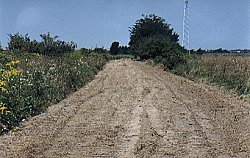
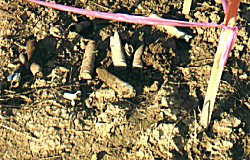
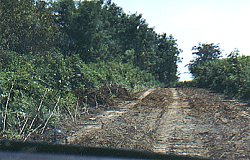
As preparation of a clearance of an area in Croatia by KMMCS an overgrown path was given by local authorities as intrance for the ever " on the scene" accompanieing medical asssictence car. This path had been "cleared" by manual deminers and then had been declared as "minefree" by local authorities. Due to the plants, that woulld hinder the normal street car driving to the field, the path was milled as vegetation operation by KMMCS. By that KMMCS found and destroyed 16 nonmagnetic Anti-Tank Mines at this path, that already was officially declared minefree and given into public use after humanitarian clearance operation. This massive fault would have totally destroyed the not protected, commercial, civilian ambulance car by detonation. For sure this would lead to extrem injuries for the medical personal, probably their death. Also KMMCS would have been in danger, if it would have travelled over this path without milling its way.
Path to the intended minefield after the vegetation clearance, which unplanned became a 16 AntiTanklMine clearance operation.
|
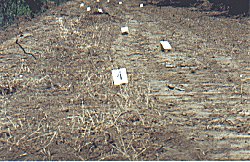
Cerified an minefree after humanitarian (=manual) demining and follow up founds by KMMCS |
|
|
|
|
|
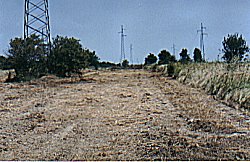
High Voltage Powerline Tenja (Croatia): this strip had been declared minefree by local authorities. Even though 16 nonmagnetic Anti-Tank Mines were found and destroyed by KMMCS. |
High Voltage Powerline Tenja (Croatia): detailled places of the found and destroyed Anti-Tank Mines . |
|
|
|
|
|
|
|
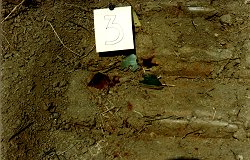
Fragments of Anti-Tank Mine No.3, destroyed by machine I of KMMCS |
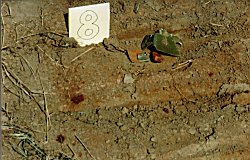
Fragments of Anti-Tank Mine No.8, destroyed by machine I of KMMCS |
|
|
|
|
|
|
|
Fragments of Anti-Tank Mine No.9, destroyed by machine I of KMMCS |
Fragments of Anti-Tank Mine No.13, destroyed by machine I of KMMCS |
|
|
|
|
|
|
|
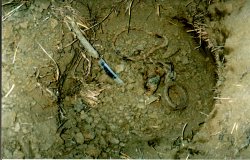
Other place of founds: as demonstration of non-dangerous metal parts at which the metal detector alarms, which causes unnecessary and long lasting safety operations, that turn out as false alarms. Up to 90% of the alarms are false. Whereas approx. 70% of all layed mines are nonmagnetic and theretor can not be detected by metal detectors. In the picture there are no mines, but civil metal parts (knife, chain of agricultural machine), found by metal detector. |
Other place of founds: Non explosive metal-remians from mines, destroyed by KMMCS. |
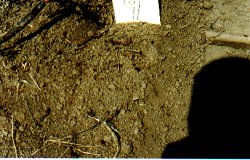
This place was the intended place, to where KMMCS milled the vegetation at the intrance path for the obviating ambulance car on the scene.
|
|
|
|
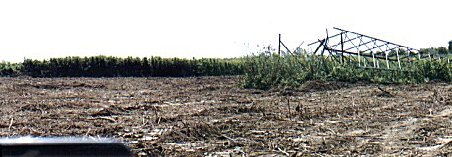
High Voltage Powerline Tenja (Croatia), after the first pass of machine I August 2001 |
High Voltage Powerline Tenja (Croatia), after the first pass of machine I August 2001 |
|
|
|
|
High Voltage Powerline Tenja (Croatia), after the first pass of machine I August 2001 |
|
Performance, Accidents, Costs of UN operations globally
The UNO from 1994 to 2000 has cleared with 500 manual deminers for civilian purposes almost 200 ha. They cleared less than 20.000 Mines. The price were over 20 deaths or heavily maimed persons and costs of 30 mio US-Dollar for their dangerous work and the administration.
KMMCS - Maschinelle Minenräumung und Bodensanierung
(KMMCS - Mechanical Mine Clearance and Soil Rehabilitation)
Tobias Steidle
Am Ehrenhain 2
D-38678 Clausthal
Germany
Tel.: +49 (0) 5323 92 21 55
Fax: +49 (0) 5323 92 21 56
Mobil: +49 (0) 170 9988 170
E-Mail contact
Ideas and mistakes please report to
Webmaster